During a retreat in Mombasa last week, I met Sig and Joy Feser, who are working in Tanzania with the Maasai. They have a heart for discipling people through the media and, as a result, began Pamoja Ministries and Kahawa Productions to forward that goal. They began with some children's puppet videos in Swahili, a photo book of the Maasai (called En-kata) and a movie musical called "Nipe Jibu" ("Answer Me") - also in Swahili, about the hold ancestors have on the lives of many Tanzanians, and how they can be free through Christ. Click here to read more about their video and TV projects.
I loved a statement they made about their work— people always hear about the ugliness, poverty and corruption of Africa; they want to promote the goodness, strength and beauty of Africa instead. Way to go! One way they have begun to do that is through a Maasai music video. Although it is sung in Swahili, instead of Maa, it was choreographed by the Maasai using many of their dance moves appropriate to the words of the song "Bwana Mungu" (Lord God). It's beautifully done, so click here to see it! The Maasai who have seen it say it makes them "proud to be Maasai Christians."
The newest God-vision the Fesers have had is to do a "Maasai opera" - basically a fusion of Maa song and dance, Swahili and English, with a storyline from the Maasai perspective of how they are dealing with holding on to their culture in the midst of social and cultural change. Their story can speak to people in many cultures dealing with similar issues, as well as sharing how their God is seeing them through the transitions.
Sunday, July 24, 2011

Tuesday, May 17, 2011
Combining drama, fashion and ministry in Liberia
 |
| Dancing for transformation |
All this was to help launch Amani Liberia, a ministry to marginalized women that teaches them sewing, production and design as a means of livelihood, recovery and reconciliation. For more on Amani, click here. Amani began in Kenya. The founder, Becky Chinchen, has since moved back to Liberia and was encouraged to start a branch of Amani there to help the women who have suffered from the war and continuing disempowerment.
They wanted to launch Amani with a fashion show, with designs donated by Korto Momolu. She told the story of separation, transformation and celebration through fashion, and Becky asked me to help develop the same thing through narrative, dance and music, supporting the fashion show with an African narrative dance. I went with the incomparable Hellen Mtawali, Kenyan songstress, and artiste extraordinaire, Alan Oyugi, to work on the choreography.
 |
| Hellen teaches a song and dance |
 |
| Alan working on choreography |
 |
| working on a dance |
 |
| final move of a separation dance |
The show began with Separation - from God, community and self-esteem; we expressed it through a narrative beautifully written by Martha Partor, a Liberian woman who has a ministry to women in the country, punctuated by dances, both modern and African, and music from Ghana and South Africa.
The first performance was done in the ruined theatre in what was once downtown Yekepa. The background of a building torn apart, but transformed by lights and stage formed a lovely background to the message of transformation and hope through God.
 |
| The Open Door Theatre, Yekepa, Liberia (2011) |
 |
| Open Door Theatre before the show |
 |
| Open Door Theatre preparing for the show |
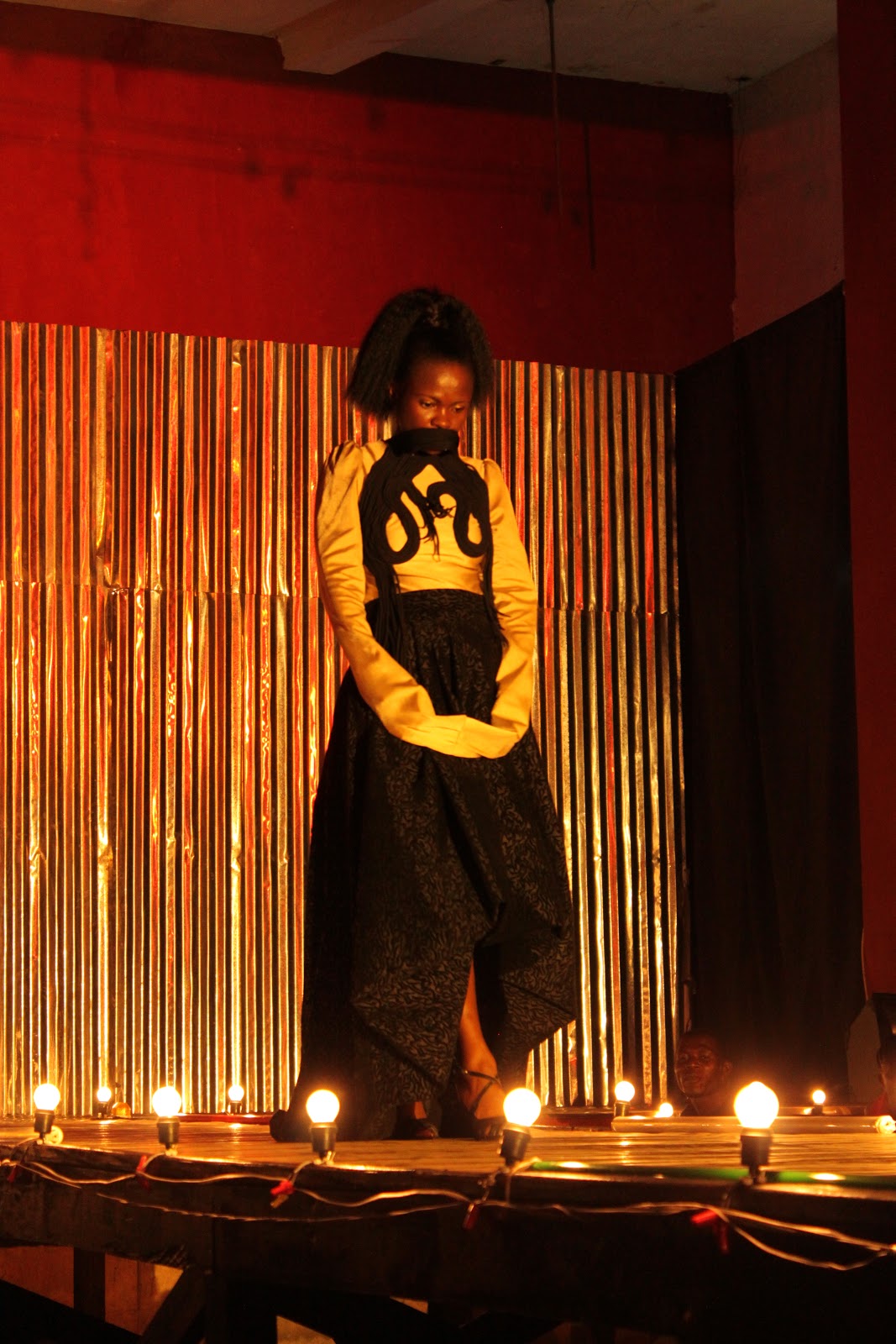 |
| Separation (by Korto Momulu) |
"All is not lost! I can dream a little light of hope. I have found someone who loves me as I am. I know some day soon, I will wake up with freedom.
Freedom to school and be a figure of my society; freedom to make my own money. Freedom to build my mind.
My body is now my jewels. My education is my husband. The work of my hands is my pride. My image is my Creator. Oh! Women of Liberia, there is hope!"
 |
| Transformation |
"I feel the glow of my beauty; I thank my Maker for helping me live again.
I am now a woman of worth; see, as I motion to other women of Liberia.
Women of Africa, come and drink from the fountain of beauty."

The show brought together the community of the Yekepa for the first time since before the war (20 years ago). And in Monrovia, it showed to a sold-out, enthusiastic crowd. It was a truly unique way to show, through many art forms, how God transforms and gives reason for celebration!
Monday, April 25, 2011
Drama, Sigana and Fashion in Liberia
Stay tuned for a report on what I'm doing in Liberia for the next 2-3 weeks! Amani ya Juu (a ministry to refugee women and those who are hurting and in need) is launching in Liberia, and I was asked to help fashion an African drama narrative around their big fashion show launch. The Liberian Project Runway designer is doing the designs, Helen Mtawali of Afrizo will be doing the music, and Alan Oyugi is doing choreography. I'm putting the music, narrative and dance together in a sigana-type drama. We just arrived and are looking forward to getting to work!
Sunday, April 24, 2011
HIStory Easter drama in Kenya
Easter Sunday - a prime day for dramas, pageants, and other creative events in churches around the world. It was no exception today in Nairobi, as Mamlaka Hill Chapel put on a narrative, storytelling, musical, dramatic worship service. "HIStory," available through DramaShare, took the place of the regular Easter morning services.
 |
| The Samaritan woman tells about Jesus |
 |
| The Last Supper |
A team of near 40 (actors, musicians and technicians) sang and acted their way through a beautiful ministry event which included contemporary retellings of the disciples, the Samaritan woman, and African versions of da Vinci's famous painting of "The Last Supper" and the crucifixion and resurrection.

The challenge for the production was mainly working with the technical aspects - turning the parking lot sanctuary into a theatre space. It took days of draping with fabric and plastic, hanging backdrops and curtains, and working with an LED lighting system that had no manuals (except those in Chinese) and no one who fully knows how to operate a very complex controller. But we managed! People appreciated the doctrine of the story and how it told Jesus' story in a relate-able way.
Wednesday, March 30, 2011
A "Work in Progress"
There's an old script, by Paul McCusker, called "Work in Progress." Since I've been in Kenya, two church drama groups have performed it to appreciative audiences. This semester, Daystar's chapel theme was "becoming mature in Christ." I was asked to do a drama chapel, so I pulled out the script, recruited by usual actors, and added new ones, and we put it on. The script is rather like an AA meeting for Christians -each session they share about themselves, their struggles (or lack of them) and try to see how they can share Christ with others. In between, we see them in their daily lives, with their own brand of Christianity interacting with the circumstances of their lives. It's quite hilarious and a good chance for Christians to laugh at themselves (is that a painful laugh?).
Performed at a local church this past Sunday and saw a great example of audience interaction, rather like African American preaching, where the audience constantly comments on, or affirms the pastor in what he's saying. Monologues on whether other Christians struggled with living in two different worlds were interrupted: Actor: "Am I the only one who feels this way?" Audience: "Oh no. You're not alone." When a Christian cliche-spouting woman's husband enters carrying a suitcase: Audience: "Where are you going?" Actress: (small moment to collect herself) "Challo, what's this? You're leaving me?" Actor: "I don't love you anymore" Audience: "(Gasp) Oh no you didn't!"
At the end, they all stand up and say, "I'm [name], and I'm a Christian." The pastor loved taking that and offering an altar call to those who wanted to be Christians or return to the Lord - and there were several. Wonderful to see drama being used in ministry that way!
A work in progress: A full-length play about Christian identity, evangelism, and refrigerator magnets (A Lillenas drama resource)
Performed at a local church this past Sunday and saw a great example of audience interaction, rather like African American preaching, where the audience constantly comments on, or affirms the pastor in what he's saying. Monologues on whether other Christians struggled with living in two different worlds were interrupted: Actor: "Am I the only one who feels this way?" Audience: "Oh no. You're not alone." When a Christian cliche-spouting woman's husband enters carrying a suitcase: Audience: "Where are you going?" Actress: (small moment to collect herself) "Challo, what's this? You're leaving me?" Actor: "I don't love you anymore" Audience: "(Gasp) Oh no you didn't!"
At the end, they all stand up and say, "I'm [name], and I'm a Christian." The pastor loved taking that and offering an altar call to those who wanted to be Christians or return to the Lord - and there were several. Wonderful to see drama being used in ministry that way!
A work in progress: A full-length play about Christian identity, evangelism, and refrigerator magnets (A Lillenas drama resource)
New Drama Commissioned for Tangaza College, Kenya
Over the past few months, I have had the privilege of being a consultant on a drama commissioned by Tangaza College for their 25th anniversary celebrations. Tangaza is a Catholic university in Nairobi, Kenya. Father Pietro is a priest who has a strong interest in theatre and incorporates and encourages it as much as possible. In fact, in 2009, he helped coordinate the first Festival of Christian Arts in Kenya, showcasing artists from all the disciplines.
Anyway, the play was called "The Last Convict" and was a metaphor for spreading the Good News of Christ. It used the metaphor of a convict facing a death sentence, with an electrician called Lightman representing Jesus - a popular image was the bucket of waste under the cot that Lightman offered to empty. The whole thing had the feel and structure of a medieval morality play, albeit set in modern Kenya. It was written by Joseph Murungu, a respected theatre teacher and playwright in Kenya, and performed by Phoenix Players, the only repertory company in the country.
The play was well done, but what was even more interesting was the question and answer session afterward with the Tangaza students. To many of them, stage plays were a new experience, and certainly this type of metaphorical play was a lot to wrap their minds around. I enjoyed listening to their questions – how did the actors respond to the message of the play, critiquing the flow of the script or interpretation of it, wanting to know about the process of creation involved.
It was a good example of how theatre can spark dialogue about faith matters, theology and art.
 |
| A scene from "The Last Convict" |
The play was well done, but what was even more interesting was the question and answer session afterward with the Tangaza students. To many of them, stage plays were a new experience, and certainly this type of metaphorical play was a lot to wrap their minds around. I enjoyed listening to their questions – how did the actors respond to the message of the play, critiquing the flow of the script or interpretation of it, wanting to know about the process of creation involved.
It was a good example of how theatre can spark dialogue about faith matters, theology and art.
 |
| Dancers celebrate the convict's redemption |
Friday, March 4, 2011
Peacebuilding through drama in Kenya

While two days was not enough time, it was a very successful process, particularly when it came to people sharing their stories to those of other tribes and persuasions. We did a morning session of Image theatre and it was wonderful to see them forget about tribal barriers as they discussed problems in their villages and worked on creating successive images to show.


Feedback – they saw the strength of dialogue among the tribes, the need to do similar workshops with the youth, seeing solutions they came up with being tried out in forum theatre, which then opened up even more discussion of issues and solutions. With pastors in the group, they also discussed the power of prayer in bringing about reconciliation.
Subscribe to:
Posts (Atom)